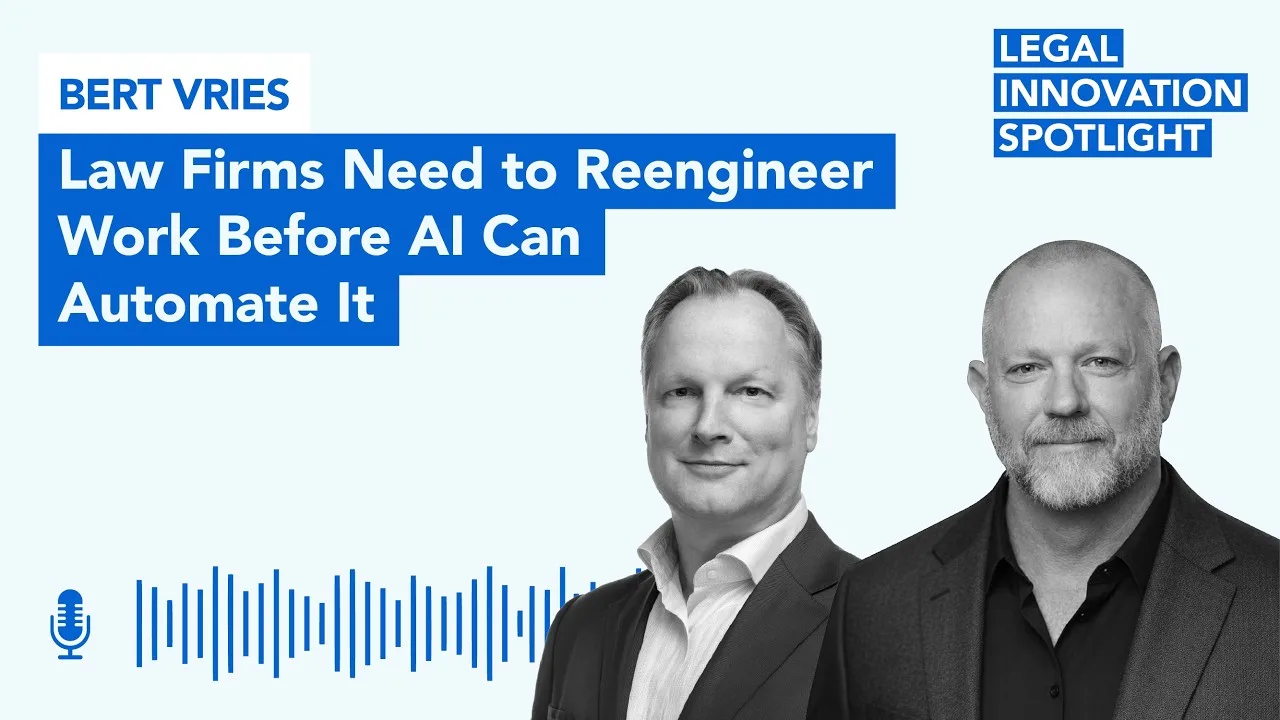
Chris Smith
In this episode, Ted sits down with Chris Smith, Chief Information Officer at Freshfields, to discuss the evolving relationship between IT and innovation in Big Law, the importance of data governance, and how firms can effectively prioritize technology investments in an AI-driven era. From stabilizing core infrastructure to enabling innovation at scale, Chris shares his expertise in IT leadership, data strategy, and law firm transformation. Highlighting the tension between experimentation and stability, this conversation explores how firms can balance risk, governance, and progress to drive meaningful innovation.
In this episode, Chris Smith shares insights on how to:
- Build a strong technology and data foundation to support innovation
- Balance the competing priorities of IT stability and innovation experimentation
- Establish governance frameworks to prioritize the right innovation initiatives
- Improve data quality and accessibility to enable AI and advanced analytics
- Drive adoption and manage resistance to change within law firms
Key takeaways:
- Innovation and IT must work in close collaboration, not in silos
- A well-architected data layer is essential for successful AI implementation
- Governance and prioritization are critical to avoid wasted investment in innovation
- Law firm culture and resistance to change can be major barriers to adoption
- The legal industry is at a key inflection point where technology investment will define future competitiveness
About the guest, Chris Smith
Chris Smith is a Chief Information Officer and Chief Data Officer with over 25 years of experience leading global platforms through transformation in legal and professional services. He works at the intersection of technology, data, and operating models, helping leadership teams improve decision-making, speed, and economic outcomes. Focused on “decision leverage,” Chris helps organizations modernize core systems, rethink how decisions are made, and build teams that deliver lasting, measurable results.
“Innovation should not be saddled with having to support an application once it goes to production. innovation completes something.”
Connect with Chris:
- Freshfields’s Website: https://www.freshfields.com/
- Chris’s LinkedIn:https://www.linkedin.com/in/christophersmithnyc/
Machine Generated Episode Transcript
Read the Full Transcript
[00:00:00] Chris Smith, how are you this afternoon? I'm well, Ted. Good to be here. Yeah. You're coming in, um, uh, crystal Clear from, you're in New York City, correct? Uh, for all practical purposes. Yes. I'm from the big apple, right across the river, actually a very cold river today, Jersey City. Okay. Yeah, it's, um, it's been an interesting, it's been an interesting winter season By the time this episode comes out, we might be into spring, so we won't bore everyone with our musings on the weather.
Um, you and I got connected on LinkedIn. We had a really good conversation. I was excited to talk to you and hear about your background. Um, why don't you, you've got a really long tenure history in big law. Uh, tell us a little bit about kind of. Uh, your background. Give us a quick intro if you would. Sure.
Um, so, uh, I found myself at Big Law at Sullivan and Cromwell in 1998, uh, doing some [00:01:00] tech work for them. Uh, basically building a, a, a data warehouse for them. Um, uh, got to know some of the partners and the executive director at the time, and he created a little home for me as their director of knowledge management.
Uh, dug in there for, um, quite some time and left when I was the CKO and Chief Innovation Officer and combined during COVID, um, left there and went to Freshfields for the last four and a half years where I created the role of the Chief data officer and stepped into the global CIO role. Um, did that for about four years and recently left to explore other things.
So you, you're catching me at a gap, uh, from my tenor. A big, big law. Interesting. Um, so in your chief information officer role at Freshfields, did you manage innovation or was innovation a separate function? Innovation was a parallel function that [00:02:00] reported to the managing director along with me, but, um, it had to be a, a, um.
A really symbiotic relationship between innovation and IT and data for that matter. So whatever we were doing, uh, we had to do with complete consent and agreement. There's a, a really important relationship between, uh, technology, uh, and it in general and innovation that, uh, was a pretty interesting, um, development through the four years that I was at Fresh Fields.
Um. When I, when I joined as CIO, there was a chief Innovation Officer, I'll go into a little bit more depth here. Um, when I took over. I wasn't really happy with the things that the innovation group was doing. They were spending a lot of money and not getting quite, uh, too much return on the investment.
And we had, um, you know, I like to describe it as being out over our skis in terms of [00:03:00] what we were trying to do. Uh, so we dialed back on the innovation, uh, efforts when. First became CIO and really went back to basics in terms of, uh, developing a platform that was stable, high performing, um, and a little bit boring.
Then after we stabilized for a bit, we reintroduced the Chief Innovation Officer role about a year and a half ago. And, uh, we stole a Chief Innovation Officer from Deutsche Bank. Hmm. So, uh, that, uh, role Gil Perez, uh, and I worked very closely for the time that I was there and we were working together and it was a, um, a really.
Uh, fruitful relationship. Um, the relationship between innovation and it is, uh, is, is gonna be different at every firm, but, uh, we etched out a, I think a pretty progressive approach to the, uh, the role of innovation at the law firm. Yeah. I'm eager to dive into that because in my. Years both [00:04:00] in big law and which I never worked for a law firm, but I've worked with well over half of the AM law.
We have a quarter of the AM Law 200 as clients at Info dash today. So I have a good cross-sectional view into law firms innovation and which is our primary. IP is Cam and I and then, but we work very closely with it. In fact, we just got off of a call, uh, today, something been escalated. Um. Because, uh, innovation team was frustrated that we weren't installed yet.
And the reason that we're not installed yet is because it has locked down all, every port, every service, every API call. Um, so it's a, it is a interesting, you know, but they're looking at us like, Hey, you guys haven't installed yet. And so it, what we find is that there is an inherent tension between.
Innovation and not an unhealthy one necessarily, but tension [00:05:00] nonetheless between innovation that's moving fast and breaking things. And it, whose sole purpose in life is to keep the business, to your point, stable, secure, um, available, um, you know, redundant and, um. You know, the, there's, it feels like there's a little bit of inherent tension.
What is that your experience having lived in both seats and then, you know, um, engaged with the other side? Oh, absolutely. Uh, you need a, there should be, um, a challenging relationship in many cases.
You know, when you're in the CIO role, you're responsible for everything that that is coming across, uh, the screen at the lawyers or through the devices. Innovation wants to come in and change and [00:06:00] introduce new ways of doing things, um, and to challenge old ways, and that's extremely important. And everybody in it should absolutely welcome that.
But at the same time. When you have the, the, you're in the role of the CIO, you have to welcome that, but you are absolutely obliged to make sure your security profile is maintained, your privacy is maintained, your budget is maintained. Um, all of those things are, are the obvious thing. And the other factor that's extremely important is the ability of your user base to handle change.
You really have to watch and, and understand that these lawyers are extremely busy. Their attention span is a very rare commodity. And anybody who's, uh, tried to introduce a new technology or a new app to a law firm, uh, or to any, uh, knowledge worker knows to, um, to get them to understand what is new and to retire doing things the old way is no small undertaking.[00:07:00]
If you're trying to, to change too much, everything's gonna fail. So not only is there there the obvious, um, antagonism between the innovation, wanting to introduce new things and the, uh, the desire of it, uh, traditionally to maintain things. But there's the third party of the people that are actually, you know, subjects of, of these change.
Their ability to, and their capacity to accept the new change is another factor that people ignore quite a bit and it's extremely important. Um. The Another important factor is there are so many things in legal tech that are changing and it could change and could improve. There has to be a body or somebody objective that's going to say, these are the things we should try and change.
Um, this is where innovation governance comes in and you not only need the, the voices of [00:08:00] the innovation people and it, but you also need representation from your partnership and from management to say, maybe we shouldn't spend half a million dollars trying to make. Our, our mail room more efficient, maybe not the best spend of our money and time.
But maybe we should spend our time, uh, you know, working on how to, uh, get our, our marketing team, how to understand how to use generative AI to create copy or something like that. There has to be some direction about where we spend our time and our attention in terms of, of what we wanna innovate. Um, that's as important as what I, as from the IT perspective or the innovation person has from their perspective.
Um, this, this discretion is an important thing that I think a lot of people miss, and that we worked really hard at Freshfields to put in place a body that had not just a few very, very key partners. The executive director of the [00:09:00] firm, um, head of it, head of, uh, information security, head of innovation, all in the same room to discuss, okay, let's, what, how should we prioritize this important point from my per perspective.
Yeah. And, and prioritization for innovation activities is, is an interesting exercise because there's a lot of, um, there's a lot of unknowns in terms of, um, a lot more variables at play in terms of like ROI, so you know, when, so in, when experimenting, like I'm a, I come from a lean black belt. Did process engineering work in, um, at Bank of America big, uh, financial services company.
And I'm very process oriented, so I always think process first before technology. And I think we're in this era right now where there's some [00:10:00] unhealthy dynamics in play and fomo, and we have to do something. So let's buy tools before we really figure out where and how we're gonna use them. Um, so I'm a process first person and, and it sounds like, you know, prior to Bank of America, I was at Microsoft, I was on the SQL team at Microsoft.
So I'm also very data oriented and having, having a good foundation, um, within your data layer upon which to build systems and processes is really kind of the first step. But law firm data. Broadly speaking is a complete disaster. There's been very little focus on data hygiene, especially on the unstructured side of the fence.
Like yeah, you know, I mean, rows and columns and finance systems. There's been some discipline around that. 'cause you know, obviously there's huge impact, but like lawyers are terrible about profiling documents. Um, within matter [00:11:00] workspaces, there's. Even getting the same, getting the, the lead attorney on the matter to go back six months, um, after, and figure out where the final, final, final version of the deliverable is can be challenging.
So, you know, it feels like we're deploying tech on top of shaky. Data layer and around processes that really even haven't been documented, let alone optimized. Is that, is that your perspective or do you see it differently? I, I have a, I understand your view, and I think a lot of law firms, um, are, are, are not investing enough here.
I I, I feel very fortunate in that both at Sullivan, Carmel and Freshfields, they, they brought me on to address the data. Issue, um, at Freshfields was very explicit. We created a data office. We instituted data governance, we instituted data operations. We built a [00:12:00] really beautiful data lake house that incorporates all the structured data of the firm that said, um, the lawyers are incredibly creative.
Um, and will do everything they can to take care of their clients. Um, if to be successful in legal technology, you have to come up with the best tools available and make them easy to use so that it's easier to use the right things in the right way than it is to use an alternative. So, in other words.
Document management has always been a kind of a, um, a sort, it's just clunky, but if you can find the best way and, and make it a very lightweight tool for them. And then use technologies behind the scenes to create metadata to par, to, to do things, to, [00:13:00] uh, make the data more useful, to make sure that it's, uh, properly secured and partitioned.
Um. To lawyer, you're gonna be more successful and this problems harder. In the last few years, it used to be that, you know, in the eighties and nineties you can say, no, you, you, you must use docs open or, uh, iManage or what have you, and, and lock everything else down. Um, lawyers are gonna use what the client wants them to use.
They're gonna use whatever tools they need to to collaborate effectively. And the best thing that we can do as technologists is understand that and educate people in terms of the risk profile that's associated with that, and do as much as we can to get the data onto the reservation. Uh, it does mean investing more in data than, uh, the partner may have thought they needed to, but hopefully it's one of the things that I spent an, an awful lot of time doing was educating the people on.
And data literacy. So what it means to have good [00:14:00] data and to make the case that, to do any of these things they wanna do with machine learning or data science and generative ai, you need a data layer that is well, um, well architected that has, um, data access control at the lowest level. So it needs not to be at the, the application level, but at the data layer so that uh, anybody who's running a, a natural language query against, uh, a, um, um, any kind of interface will get what they're supposed to see and not see what they're not supposed to see.
But, but that's tricky. Uh, there's no one application you can buy for. You do need to know the tools, be it a Microsoft stack or a Google Stack or something else. Uh, and it needs to work between the applications that we all use in big law in terms of your doc management, your Salesforce, your, your elites and those things.
The, the data layer layer is something else on top of all of that. I'm rambling a bit. I hope that's on topic today. No, that's, that's [00:15:00] helpful. And, um, what about those. Conflicting objectives. And I do think they're, it's not an overstatement to say that they're conflicting, but you, you may feel differently.
You know, when I think about it's remit, it's, it's uptime, it's um, mm-hmm. Uh, absence of defects, it's no security breaches. Um, it's proper documentation all very. Kind of risk centric. Um, and then, you know, with the remit of an innovation officer, you know, or an innovation function, um, I don't know that this happens, but I do think there should be some measurement in KPI around how many experiments are we engaged in, and what's the success rate, and if the success rate is too high, I, I would ask the question, are we, are we truly innovating or are we.
[00:16:00] Improving. Is this incremental improvement or are we, are we actually innovating? Because I do think there's a difference and, and the difference being improvement is incremental. Um, innovation is, is foundational. Um, and that's, those are, there's a lot of devil in detail there. But, uh, do you see that the, the, the same way as there's, uh, a little bit of, um, um.
Give respect to it's relationship to innovation there. I'll say two things about that. I, I think, yes, the innovation group in the innovation office should be, um. One of their metrics should be the amount of products they review and the amount that they, they, uh, put through a, a, an organized pilot process and the, the evaluation of the outcomes of all those things, what they're generating are candidates to go [00:17:00] to production.
At which point it takes over and runs it. As in a mature world, innovation should not be saddled with having to support an application, uh, once it goes to production. So the, you know, innovation completes something, it goes to change management, it goes into the, the canon of what it will support and deliver to, um, the user base when that gets blurred.
Innovation and the IT relationship can get problematic. Um, and this is really important when you get to a place where you have 2,800 lawyers and you're, you know, around the globe, uh, you really wanna be, have somebody who can answer every question there, 24 7, 365 and innovation. You, you, you're not gonna staff for that.
That's not the kind of professional you want there. So that's an important thing that I think will keep. Everybody more successful in the long term if they think about that kind of relationship. The, um, [00:18:00] the other thing that to, to really be on board with, and this goes up to how I and, uh, the team work with the managing partners of the firm.
The outcome is servicing our clients better and making our lawyers more powerful. I don't really care who in technology does it or who in support staff do it, but we are all there, uh, badged to the same as our, our partners trying to work together one way or the other. I don't know who's gonna come up with a million dollar innovative idea.
More than likely it's gonna be one of the partners who's got a great idea working with the client, with, um, I can help them realize it in technology along with the innovation team, but keeping the focus at that level. I think helps everybody involved that can, you know, let's say dull down the antagonistic relationship between innovation and it, um, [00:19:00] to give, to give them a com a common goal.
Um, I feel very, very strongly about that idea. It's, it's really important for, to remind people of that. How does vibe coating muddy those waters? Um.
Great question. Um, I, I, I love the idea of vibe coating. I love the idea of somebody a, a, uh, an associate who spent a weekend coming up with something that, and bringing it to, and challenging, uh, a programmer with little gray hair and a bit of a gut from seeing a, sitting at a terminal for 20 years. Um, yeah, bring it on.
Challenge, try, gimme something new. Uh, I don't care where it comes from. Um, now. If you're a good coder, you're gonna be able to look at the say, okay, this is a great idea, implemented in this. Let's make it better together and put the ego aside and figure out how to do something and learn from the idea coming from outside.
I [00:20:00] love working with people that have the confidence to do that kind of thing. Yeah, I think there's a little bit of, um, learning. To be done around Vibe, coating's place. It certainly in its current iteration, like I see tremendous value in enabling people within the business. That could be within the practice, it could be within the innovation team to shortcut the requirements gathering.
Building the business case processes, right? Yeah. But that's, that's it. It stops there, right? You don't roll anything out or even use it in a production capacity on anything other than test data until you've engaged your technology partners to have it fully vetted and, and, you know, 99 times out of a hundred rebuilt.
Using the enterprise architecture that the firm requires and the source control and the, you know, the, the, [00:21:00] the pen testing and all those sorts of things. But I think people, speaking of getting ahead of your skis, I think people are getting a little bit ahead of their skis thinking that you can spin up Claude code in a weekend and build a tabular review.
Feature and then go on Monday and use that with client documents. Um, that's just not where things are today. I don't know if we'll ever get there, but we're definitely not there today. Would you agree? Uh,
my gut says agree, but I've also, I've been proven wrong so many times in, in my career. Um, it comes down to the business too. I don't want. A partner or an associate who I can bill out for a thousand bucks an hour writing code as much as they want to. I mean, I'd love the idea, and if they have [00:22:00] the idea and then the drive, great.
But it's, it's not, it's, the business won't sustain that way. It's, it will better off getting them to collaborate with a, a technologist and use their time more efficiently. Um. You, you get into the, um, agentic AI policies and, and governance and, and it, it does a couple things to, uh, to the organization. You need to make sure that your core technology stack will protect against the ambitious vibe coder.
So, in other words, your data needs to be protected and such that it's impossible to use it in incorrectly. Uh, your, um, you need to. Lock things down so that you can't release an agent to every person at the firm if you're, if you don't have the appropriate permissions. So, so those are some of the challenges we have as the technology changes.
Um, then you get into the, some of the things we talked about earlier, the [00:23:00] attention span of a lawyer. The complexity of the, of the software is that you're releasing to your knowledge workers. Uh, and you, you don't wanna confuse people too much. It's just, uh, it's gonna hurt more than it helps. So this gets into governance.
And two, a lot of what we in legal have to deal with in terms of, um, diplomacy. You know, this is not a top-down organization where Chris says X and everybody does that. No. You have to convince people, y uh, it's better to do this things in a different way. Uh, and that just takes an awful lot of time communicating.
Uh, particularly in technology leadership and, uh, and getting people to understand how things are happening and, and how these technologies are changing and where they could be useful. So, because I do wanna, if there's an opportunity and there's a brilliant billion dollar idea somewhere at the firm.
That'd be an amazing thing to, to take on Freshfields is really interesting. Even before [00:24:00] I joined I had a team of data scientists, scientists working with, uh, directly with partners in the Berlin office, the Freshfields lab, and they did a lot of really creative, uh, machine learning projects, uh, directly for a lot of our big clients.
So there was a history where they had a, a high degree of independence and a good relationship with it. Um. The boundary was purposely gray the entire time I was there, and we kept it gray because I wanted to support them. I wanted to support the amount of creativity they were bringing to the job. Um, at the same time I had to protect the estate.
So it, there were week weekly meetings where we discussed what was needed to, to work together. It was a really, kind of a tricky, but a very fruitful relationship with that team. Interesting. And you talked earlier about you guys did a reboot of the innovation function there when you first joined. What are signs that [00:25:00] a reboot is needed?
What does that look like? The, um, there were a couple things that, there were, um,
a lot of the things that the, let's call 'em. The legacy innovation team was doing, uh, they were, um, a lot of the investments just were not taking off. People were spending a lot of times, uh, trying to implement things that the lawyers just did not find as useful. Uh, and there was not a lot of discipline around their choices in terms of what they were doing.
So there were, it was a lot of vendor led, um, implementations and a lot of, uh, product, um. And it was a pretty easy, uh, and obvious case to look at, okay, what are we investing in? What's being used? And just said, oh, come on guys, this is, this is not justifiable. Uh, the second [00:26:00] thing was there was a lot of frustration for some of the things that were getting used because the innovation team was trying to be a support organization as well.
And then a as large an organization as Freshfields was, that was just not successful. They were not able to, to keep people happy, particularly on nights and weekends. So those were two of the, the red flags that said this, this wasn't working. Smart people, very smart people that knew what they were doing, but uh, the motivations and the incentives weren't correct.
In other words, they weren't incentivized to, um, to actually move the needle in terms of more effectively servicing our clients. And they were, go ahead. I was gonna say were they, it sounds a little shadow ITish was there some shadow it there? It.
On the surface it was, but it was, you know, doing their best to stay involved. Yeah. But they were driven, they, they weren't motivated. Um, you know, one of the important things in it is you [00:27:00] have to be really tightly integrated with every functional area at the firm. So not just, you know, the, the, the legal ops side, but marketing, finance, uh, recruiting, all these organizations.
You all ev everybody needs to be working together to talk about the, the scarce resources that our technology and attention span. Um, so. Yes, there was some duplication and that's why when, you know, when I joined Freshfields, uh, we were going through a, an initiative to, um, to radically change the way we were doing it.
Um, when I joined, there were 485 people in the IT organization and we went down to 130, um, by some, some strategic outsourcing, uh, decisions that we made. Um. That was, and, and at that time, that was the transition point where we changed our, our approach to, uh, innovation as well. And, and you talked about, um, and you and I, with the last time we spoke, [00:28:00] we, we talked a little bit about bringing in people from the outside of the industry.
Mm-hmm. And, uh, we share, uh, we shared that perspective, some of the best people in the innovation function. Are, are, are new to, to the industry. And I think it's just bringing a different dynamic, especially financial services. Like financial services in my view, is probably at the top of the list or certainly near it in terms of.
Technical maturity. It's, it's a requirement. It's the most heavily regulated industry there is every, the alphabet soup of regulators, finra, OC, c, fed, um, you, I could rattle off 30 of these organizations, federal and state, that that scrutinize, um, what happens at law firms. Both, you know, from a process, front end customer facing perspective, but certainly.
Um, [00:29:00] you know, in the bowels of the organization within technology. So, you know, bringing somebody in from like financial services sounds amazing, but I'm wondering would they struggle with. The current state and how resistant to change most legal organizations are like, we've seen a wave of consultants come in from the McKenzies and the BCGs and the Bains into legal, and I'm wondering, I know a few of them and I think there's a little bit of frustration reading tea leaves.
While they were brought in with big promises in terms of we're ready to change, leadership is committed to this. And that part was true. But what I think is happening in some of these firms is that middle tier within the practice, uh, I would call 'em senior partners, equity partners. Um, there's still a lot of, um, [00:30:00] friction.
Towards change at the top of the organization that made those hires, they wrote big checks to bring these people here. A lot of 'em were, many of 'em were partners in these, in these firms. And at the bottom, you know, the associates of councils, the junior partners, they're digital natives. So they're, they have a natural, um, bias towards change.
And, but in that middle tier, I think I'm seeing less. Um, I'm seeing more friction and I think that people are getting frustrated a little bit. Who, who have been brought from the outside. How do you manage that? The, um, I recognize what you're talking about, that, that it's inconsistent. Um, it, it's hard to generalize because I've seen, um.
You know, people that have been at firms for a long time and are just really motivated to constantly stay up on the, the latest and, and revisit all sorts of ti [00:31:00] things. And then I also see people that are kind of retired in place that want to keep things going exactly the way they used to. Um, they're
on. On me or anybody in leadership to, to build a team that has the personality that you're looking for. Um, the, the, the people that, um, are, have the confidence to let go of old ways of doing things to try new things. Um, that's within the people you can. Can, you know, directly influence those? You can't. And, and this is managing by, um, by, you know, coercion and or convincing people.
You've really got to make your case for the new things and you have to demonstrate, um, effectiveness using new ways and new technologies. Um. You have to be very sensitive to and listen very closely to who you know, where people are coming from. Um, [00:32:00] one of the, the things I was lucky enough to do when I joined Freshfields was to, to spend a lot of time talking to a lot of partners and to a lot, a lot of.
Different people throughout the organization before I even joined to understand where they were at in terms of what was working, what wasn't working, what their problem sets were, um, what their attitudes were to the people and technologies they were confronting every day. Um. Freshfields was very interesting because it was a, um, a very large organization, very culturally diverse across Europe and the UK and, and the us and there's, there's definitely, um, trends, I won't say, you know, stereotypes, but trends in terms of the way people dealt with change.
So those things, um. I think are really important and you have to be sensitive to them. You have to talk directly to people's anxieties in terms of what change means to them. Um, [00:33:00] the most important statement is that, um, people fear loss rather than change. So if they look at something that's going to change, they're saying, okay, what will I not have?
If or when this goes into place. And you have to understand that as a, as a, uh, change agent and, and really talk to it and, um, and confront those fears and help people through them. Uh, those are just the, it's all, it's, um, these are soft skills, um, that are, I think, really important and to the hard things of getting technology.
And
if you're, you're. Sensitive to them. Yeah. You were able to recruit from. Microsoft, Amazon, Gilead. Like how, and which I find, I find that really amazing because I, you know, I could tell you, so when I was at Microsoft, this is [00:34:00] going back, uh, 25 years, actually longer, 27 years. It was like the late nineties. And if you would've asked me and I was, you know, um, an up and comer in the tech space.
Had the, the certifications and the latest and greatest skills. If someone had approached me and said, Hey, would you wanna go work at a law firm? Even at that young age, that would've been the last place I would've said yes to. Which is funny. I'm here now. Now when you get older, one thing I've noticed is as I've gotten older, who's older, you're, you're not old.
What are you talking about? I, I'm almost 54. I'm no spring chicken. Um, but I, I see it as opportunity now. Like, I see all of this, um, you know, all of these things that need to be changed as opportunity when I was younger, I would see it more as obstacles. Um, but yeah, I find it amazing that you were able to recruit from these tech companies into [00:35:00] a law firm.
Was that, how did you do it? Uh, well, well, I was fortunate to work with a good. Team at Fresh in terms of getting me the people to talk to. Um. When you are working, uh, in an organization, um, there's a couple things that matter. The business you're in is, is one thing. Most people, if you're working at Microsoft, you've never heard of Freshfields or Sullivan Cromwell or anything like that.
Uh, you, you've only heard of Google and, and Amazon. Um, but then you realize about the kind of work that Freshfields or o Sullivan Cromwell does. And that you are working with people that are changing the world and having an effect on business. That's really kind of cool. And then if you tell them, okay, if you come and work with me in technology, you are going to have a far more significant role [00:36:00] in this firm.
Than you can potentially ever do at Google or, or Microsoft. So you are going to your value. The, the, the contribution you're gonna make is extremely significant. And by the way, you are right now joining an industry that is going to change drastically. This is a 200 60-year-old. Organization and you are going to be part of the group of people that changes the way that law is practiced for the next 260 years.
If you can find people that you can motivate. Tell that story to and get, bring them to your side, you're gonna build a team that's gonna be really successful. Um, and, and, you know, first of all, I need to believe that, and I do believe that when I'm working with some of these law firms, it's important work.
Uh, it not just, uh, you know. Punching the clock, you're going in there and actually changing business, [00:37:00] changing politics, changing policy, uh, and you can contribute to doing that if you join me. So I have to believe that. And then I have to get that message across to the team, and I have to make sure that the team buys into it and understands it doesn't just do the work they're doing, doesn't just monitor a a, an IP stack.
They need to understand why that they're, why they're doing, and what that. Role has to do with the mission of the firm. So the CIO you are communicating all the time. This is, and you're hopefully gonna motivate people to, to like, and, and do good work. 'cause you can't tell them what they, you need to just, you want people that will understand what the, the mission is, go and figure it out on their own.
You can't micromanage all that. Long-winded answer. Yeah, I think that, uh, that's kind of the approach there. Make ma makes sense. Yeah. I think now is a different conversation than it would've been even five years [00:38:00] ago in terms of mm-hmm. Opportunity for change in the middle of a, a transformation, like you could make a real business case for everything you just said.
I had a, there's a, a, a guy on the podcast, he's a listener. Darryl Cross, if you're out there, I'm, I'm giving you credit for this. Uh, he's with NRF and he, he coined a term I, I assume he coined it. He's how, where I heard it called deep admin. And um, I talk about it a lot because it really captures, I think, a dynamic in law firms that doesn't get talked about a lot and.
Um, deep admin is, are those back office functions that support the practice, finance, marketing, it, km, um, you name it, hr. And in many cases, the leaders of these functions were literally handpicked because of their resistance to change. And this is especially true in what I call mid law, which is that.[00:39:00]
Everybody defines mid law differently at info dash. It's um, like the 150 lawyers to, um, let's say 500 in that mid law space. I, 'cause I have friends who sit in the, in the CIO role and they've told me, Ted, my job is to keep the lights on and spend as little as money as possible. If I do those two things, I stay employed.
And so they, you know, there's one, one fellow in particular, he'll, if he is listening, he'll know. 'cause he, he, that's a verbatim quote, but he was literally handpicked because, um, he doesn't like to spend money. He's naturally a just a conservative guy. And now we're in a, we're in an era where I don't know that that mindset is really.
Um, aligned to the thinking that we need to have when it, it, we need to have discipline for sure, but spending as little money as possible on tech isn't, I don't think, aligned with [00:40:00] where we are in this, you know, um, transformation. So, I don't know. Did you, have you ever experienced that? Do you agree that there's that dynamic?
Um, what are your thoughts on that?
I'm not surprised. And I do think there are organizations that run that way and, um, they're successful and you, you, you don't argue with success. You know when you come down to it. There you can make the case. We're a law firm up until. In my career, we've introduced the intranet or the internet and, and computers to lawyers.
This business has been going on for a long time on paper now. Um, I believe that the technology is changing, has changed things a lot. Will change things a lot more.[00:41:00]
Cost containment, stability, uh, and security containment model. Um, I don't believe that. My personal belief is, I don't believe that's going to live as long as some of these other models. The opportunity to, to scale, uh, as the, the nature of the business changes with generative AI and some of these new technologies.
Um, I think if you are in that defensive mode, you're gonna get eaten alive. There's going to be a lot of consolidation. Uh, the things that you used to need an associate for, you're, you're not going to need. At one point. The, the whole idea of being a lawyer. At the top end of the profession is going to involve, um, a certain amount of proficiency with these new tool sets and quite a bit of data literacy that they didn't have in um.[00:42:00]
I'm seeing it from a lot of brilliant partners. They're, they're the ones that are really, uh, on the edge of this and seeing the value and exploring and curious and experimenting and insisting on their teams and experimenting. So I, I think in terms of evolution as the, the kind of leader that I want to be, um.
It's not an attractive job to keep the lights on. The lights need to be on. Um, I gauge my success by how few phone calls I get in the middle of the night, and I'm pretty happy when I get very few. But you do need to push, um, even if you're, uh, you know, an operational CIO, you really do need to understand what's how, because staying the same is just not, not gonna help you in the long run.
And I, I would, um, you know, I'm not, I don't wanna devalue the importance of the operational mindset and the people [00:43:00] that do that. It's extremely important that that's done well. Um, I just look for people that look to do things well with as little effort as possible. Makes sense. That's, yeah. You know, I had a post, uh, this week.
There was a, uh, Citibank and Hildabrand Consulting put together an annual. Client advisory and these are 20, 24 numbers. But if I had to guess, there's probably only incremental change for 2025. They haven't closed out the year, but, um, law firms spend on average 2.4% of revenue on technology to put that in perspective like software and tech.
It's like nine to 15%. Um, banking six to 12 professional services of which legal services is a subset of spend three and a half to five. So we are. [00:44:00] As an industry way below our knowledge industry peers, and we're in the middle of a massive tech transformation, and the good news is it's increasing, it increased from 2023 to 2024 by almost 10%.
That's the biggest jump there's ever been. My, my question is, are we moving fast enough? If I were running a law firm right now and I, we were spending, we had that amount of resources allocated, I think I would try and put us on a three year plan to double or triple that number in, in order to really double down, uh, and do so in a discipline way.
But I don't think 2.4% is going to, um, get us to the other side of this transformation intact. Given how much. Technology is going to be involved in, in service delivery. Yeah. Um, of course, I'm gonna say we should spend lots and lots and [00:45:00] lots on technology, but, um, the, I, I do think that's important. There's a couple things that I think, um.
That are probably embedded in those numbers. A lot of, uh, firms spread out the technology spend into different functional areas, and it doesn't always show up in those survey, those surveys, so that the numbers probably higher than two to 4%. The, the thing that I think is, um. Really important, and this is as, as gen AI and the tools improve, I think it's going to become much, much larger because I think what's going to happen is that our workforce is going to be partially.
And at that point, um, yes, it's going to increase, but the revenue should commence. Certainly increase. Increase as well. So the numbers [00:46:00] will go up, but I believe that, uh, the revenue numbers should also, uh, improve. At the same time, if they don't, there's not gonna be a lot of, uh, incentive to invest. So, um, and I do think you'll probably start to see, um, you know.
Some striations in the industry too, that you'll see a lead pack that's investing a lot more. Mm-hmm. Um, you'll see your defensive sector that's just trying to keep the lights on, you know, try to cut costs. And there you're gonna see some, some differences in performance over the next couple years. I think.
Um, we are right now at an inflection point. Ted, I think this, you are perfectly correct about that. Um, these next two years are going to be crucial. Yeah. Um, and in terms of the, when I hear firms, I think I might've told you the story. I, I had dinner with a CIO at a conference the night [00:47:00] before a conference started, and, you know, he had mentioned they're about a five, 600 attorney firm that, you know, we're physically conservative.
Was kind of the talk track and you know, I'm thinking to myself, yeah, that talk track made a lot of sense when there wasn't a disruptive technology knocking on the door, potentially threatening the entire business model that the current industry is, is based on. Um, and I think there's gonna be some consolidation and you know, the legal market is the most.
Fragmented market. I've industry I've ever really looked at, like the closest adjacent market to legal is, feels like accounting and consulting. And if you look at like the big four, um, they're combined revenues about 220 billion. Um, if you, if you combine the top 100 law firms, the AMLO 100, it's about 160 billion.
160 billion. That's like EY and Deloitte, right? Yeah. Versus a hundred [00:48:00] firms. Right. So there's, there's a, um, and I think there's so much fragmentation because of the bespoke nature of legal work. It's hard to scale organizations that operate like law firms historically have, where everybody kind of has their own process.
But yeah. I'm curious, do you see maybe consolidation, like those firms that are investing and, and leading. This, you know, going all in on this, maybe being able to snap up some of the firms that slow played and, you know, took their time, uh, transforming Well, we're, we're seeing it. Um, you know, it's, it's going to be, um, a smaller number of, of large firms.
Uh, that invest accordingly. Um, there, there will be firms dying off. Um. The, the, um, you know, there's, there's [00:49:00] always that outlier question that was, uh, will there the, um, the non-law firms start to do legal work, the alternative providers ever start to eat into, uh, um, the industry as well. It's a smallish business.
Um, you know, there's, there's AML 100, the AML 50, um, taking most of the business. So, um, it's. And the fact that it's partnership driven, um, make it a really interesting, um, closed community, um, because it's a relationships, uh, sale most of the time. This is not anybody that's looking to do an awful lot of cost work.
They're just looking for the highest quality, and that's people. Getting the best people with the most, uh, the least amount of friction to get your job done is what people are looking for. Um, so I, I do agree that that's going on. Um, it's, I'm always surprised by how slowly. It's happened. Um, you know, [00:50:00] it hasn't really changed much in the 25 years I've been working with lawyers.
Um, it's fascinating, but you, you can say, okay, well this time, is it gonna be different? Is it, is there going to be a, the pressure, the commercial pressure to, uh, to come down, bring costs down to be more efficient, to start doing more, um, fixed cost pricing on, on, on things. Maybe it's probably the best chance in my career.
Yeah. You know, I think that, you know, there's um, there's a lot of dynamics converging. There's a ton of pent up demand on the buy side for efficiency and cost reduction. Um, yeah. Am law firms, uh, am, am law profitability has, have, has risen every year since the Great Recession and, you know, margins are at all time highs.
2025 is a record year for firms and you [00:51:00] know, you've got. Corporate legal teams looking at that going, man, uh, we're spending way more than we want to. So, um, well, this has been a really good conversation, Chris. I, I really enjoyed talking to you. You're a very thoughtful guy. You bring a lot of really great, interesting perspective, especially having sat both in the innovation and the CIO seat.
So, uh, yeah, I really, uh, I really enjoyed our talk. Well, thanks. It was great talking to you, Ted. Nice, uh, covering a few topics. Yeah. And hopefully, uh, enjoyed the call. Hopefully we'll, uh, we'll see you soon. Um, thanks for coming on. Absolutely. No, you're welcome Ted. Alright, nice. Take care. Thanks for listening to Legal Innovation Spotlight.
If you found value in this chat, hit the subscribe button to be notified when we release new episodes. We'd also really appreciate it if you could take a moment to rate us and leave us a review wherever you're listening right now. Your feedback helps us provide you with top-notch [00:52:00] content.