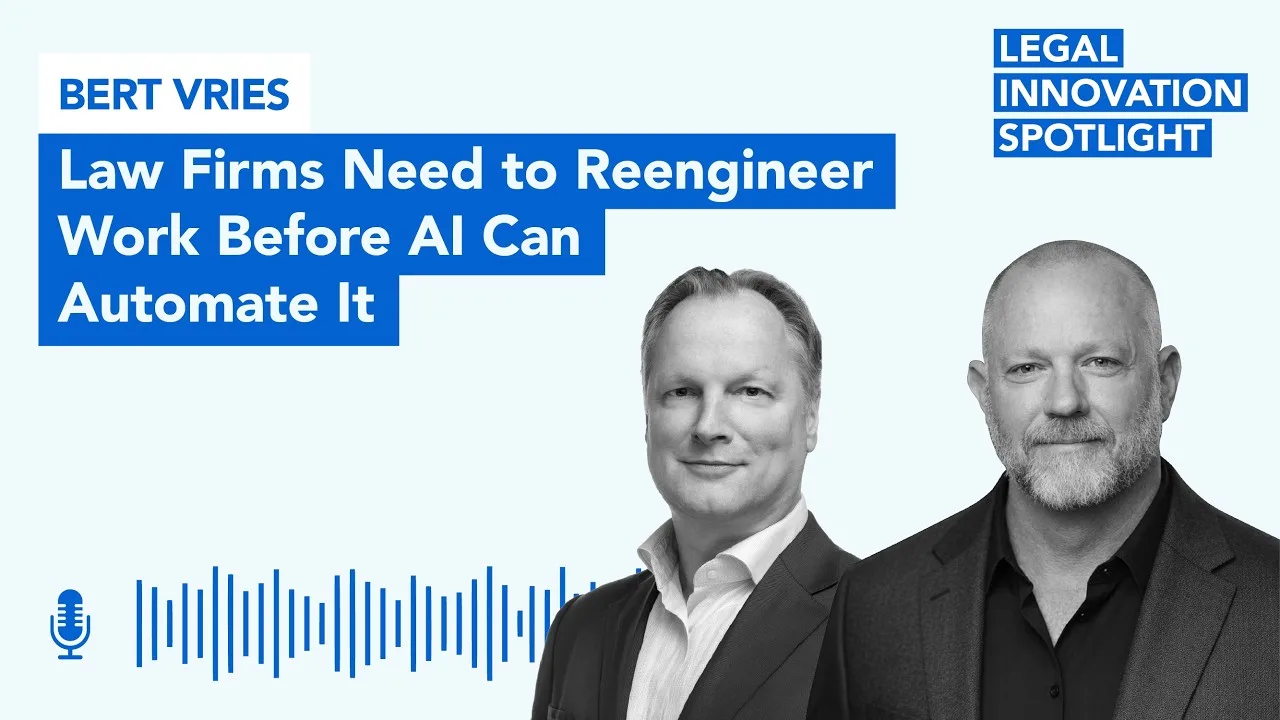
Oz Benamram
In this episode, Ted sits down with Oz Benamram, Founder of SKILLS.Law, to discuss how AI is transforming law firm strategy, the future of legal service delivery, and what firms must do to remain competitive in a rapidly evolving market. From rethinking traditional business models to helping firms navigate organization-wide change, Oz shares his expertise in legal innovation, knowledge management, and AI strategy. As the legal industry enters a true transformation moment, this conversation explores why success will depend on strategy, culture, and execution, not just technology.
In this episode, Oz Benamram shares insights on how to:
- Develop a firm-wide strategy for the AI era instead of treating AI as a standalone initiative
- Use knowledge management and process engineering to create lasting competitive advantages
- Lead organizational change and build a culture that embraces innovation
- Deliver legal expertise in new ways that strengthen client relationships and create additional value
- Prepare law firms for shifting market dynamics, AI-native competitors, and the future of legal services
Key takeaways:
- There is no AI strategy. The firms that succeed will integrate AI into their overall business strategy rather than treating it as a separate initiative.
- The biggest challenge facing law firms is change management, not technology implementation.
- Knowledge will become one of a firm’s most valuable assets as AI enables legal expertise to be delivered directly through client-facing solutions.
- AI will reshape the economics of legal services, creating new opportunities for firms that rethink how legal work is delivered.
- Firms that invest in people, processes, data, and technology together will be best positioned to thrive in the next generation of legal services.
About the guest, Oz Benamram
Oz Benamram is a recognized leader in legal innovation, advising law firms, legal technology companies, and investors on AI strategy, knowledge management, and business transformation. Drawing on decades of experience leading knowledge and innovation at some of the world’s largest law firms, Oz helps organizations rethink how they deliver legal services in the AI era. He is also the founder of SKILLS.Law, a global community for legal transformation leaders, and co-author of the book Law, Reinvented.
The true innovation happens with the people who do the work, do it better. What I’m excited about this whole AI wave is that it makes it so much easier for creative people who understand the nuances to come up with better solutions.
Connect with Oz:
- Oz’s Website: https://benamram.com/
- Oz’s LinkedIn: https://www.linkedin.com/in/ozbenamram/
- SKILLS.law’s Website: https://skills.law/
Machine Generated Episode Transcript
Read the Full Transcript
[00:00:00] Oz, good to see you this afternoon. Great to see you. How are you, Ted? I'm great. Man, this is a long time coming. I've been trying to get you on the pod for years, and we're finally making it happen, and I'm excited about that. Absolutely. So I think pr- uh, you know a lot of people in this space. Probably most of my audience knows you, but for those that don't, um, give us a quick introduction. Tell us who you are, what you do, and where you do it. So I started as a litigator abroad, came here to do IPOs, uh, and then in 2000, the market died. I switched to eDiscovery. Uh, I had an idea for a search engine that became Recommind. Uh, so I was at Morrison & Foerster at the time. I switched to, uh, do knowledge innovation. Uh, 2008, the market died. I switched to White & Case. Uh, and then, and just before the pandemic-- So every time there's a crisis, basically, I'm moving. So follow my trajectory, you know a crisis is coming. Uh, I switched to Simpson Thacher. [00:01:00] Uh, then in the last couple of years, I was advising law firms and legal tech companies on AI strategy. Uh, and I just recently joined Simpson-- I'm sorry, just recently joined, uh, Pillsbury, uh, uh, to help with the AI and knowledge initiative here. Uh, I also run skills.law, where we bring together transformation knowledge innovation leaders, uh, to share information about market, what's market. And most recently, I published a book, uh, with Adam and Rebecca, Law Reinvented, uh, about, uh, how law firms and legal departments and the sector needs to adapt to live in the AI era. Awesome. Well, the book is very timely. I, I feel like this transformation that the industry is undergoing seems to be accelerating rapidly. Uh, you know, it feels like something changed from a technology [00:02:00] perspective late last year, and it's been one, you know, innovation after another. These models just keep getting better and, um, so your book is timely. Tell us a little bit about w-what the book is about, what-- who your target audience is, what you want your readers to take away from the book. Yeah. Uh, let's start from the end. The, the, the readers should understand that, A, this is a true transformation moment, a transformative moment. It's not another tech bubble. Uh, it really changes many things. Uh, there is no AI strategy, there is a firm strategy or, or legal department strategy or, or legal tech strategy, because it affects everything we do. We're gonna do it differently. Uh, the reason it's gonna be this time for real, uh, is because The clients are complaining about the economics of law firm [00:03:00] relationship for a long time now, and it was supply and demand, right? The reason we-- they kept complaining and we kept raising our rates eight percent is because we could. Uh, and I think the AI affects both sides of the equation. The supply is going to grow a lot because lawyers plus AI can do much more, and the demand is going to shrink because client plus AI means fewer phone calls to the law firms. So that will change the buying power in the conversation. It will also give great opportunities. So the way I help clients of law firms think about what AI is to them, I think there are five buckets that you need to think about. The first one is deflection. As a legal department, you now can use AI, and nobody comes to you. And so you could put the, the NDA form and the NDA playbook on the company portal. Instead of getting the phone calls and being the bottleneck, your business people can automatically deal with it, download the thing, get the comments, upload, get the playbook, [00:04:00] and get it approved, and you have a dashboard, et cetera. So that's deflection, work that you as an in-house don't need to do. Uh, the second is you just do more with less, right? You have AI, so you can do more with the same number of people that you had. The third one is work that you take away from your law firm. They used to go to law firm, which is very expensive, but now with AI, you could do it yourself. The fourth one is getting more for less from your law firm, right? So now that law firms have AI, they can do it faster, cheaper. And the fifth one is the most exciting one. It's where the revolution-- Everything I told you until now was evolutionary. They're just a little better, faster, cheaper. The revolution is all the new things we couldn't have done before, and that's where the opportunity is for everyone, in-house and, and, and at law firms. And that's where the exciting part is, and that's why I joined Pillsbury because there's really a appetite to play into that area and take advantage [00:05:00] of, uh, all the possibilities. So I'm not sure if you're aware of this. I-- When I first started my journey in legal 15 years ago, my first legal client was a default services firm, and this is shortly after the Great Depression or the Great Recession, and, um, business was booming. And I'm a Lean Six Sigma Black Belt and a former Microsoft engineer, and I took those skills. I hired, uh, two other black belts to help me, and we re-engineered all of the work that they did at this firm. We organized, um, we organized their staff like an assembly line, and we created pods. We put monitors up on the floor with control charts. We could see bottlenecks. We could see where the process was, was slowing down. [00:06:00] And, uh, the ABA Journal wrote an article about it, um, and I really thought this was the beginning of a revolution w- that, that all law firms would do this and that my phone would ring off the hook, and it was crickets. Uh, this was a outlier, and I couldn't believe that there wasn't a really strong appetite to really get in and standardize the way that legal work gets delivered. And it was very naive of me. I understand well now that the motives s-sometimes run counter with the billable hour. Uh, most of this work was done on an alternative fee arrangement- Right ... so it made a lot of sense. But, you know, I feel like we're heading into an era where the bespoke approach that l-law firms have historically taken with much of the work, you know, in commoditized areas, there's, there, there has been some [00:07:00] standardization. But I feel like with this application of technology, there's gonna be some real process work and, and process engineering that has to happen. Do you feel like-- And some data, you know, cleanup and transformation that needs to happen, some cultural transformation that needs to happen, um, and, uh, you know, even everything down to the underlying business model, the, the, the law firm partnership model that operates on a cash basis. Like, all of that has to change in order for us to come out to the other side successful, in my opinion. Question to you is, do you see it the same way? And if the answer is yes, do you feel like we are moving in earnest in that direction? So generally, yes. Uh, I don't know that law firms' business model must change, uh, and definitely not for the-- not to start the revolution. Uh, you see, uh, recently, uh, so we are recording in the middle of May, uh, [00:08:00] and recently, uh, Linklaters just announced their applied, uh, uh, group of, of intelligence to clients. They're building products per matter, not per type of service, not for things. Per matter, they bring, uh, uh, lawyers and engineers to solve client-specific problems i-in a bespoke way, but using AI. So not everything has to be standard. Clearly, there is benefit for standard when you could find it. AI will help us find the standards, and it will help us identify our, uh, most common way of working, right? It, it's gonna operate... Many years ago, uh, Thomson Reuters tried to, uh, roll out a product called Panoramic. Uh, Panoramic tried to map the way we do the work, and it was rejected by the market because lawyers hated the idea of check the box and move to the next step [00:09:00] And nowadays, A, it's much easier to build it, but it also, you don't have to work inside the paradigm for this to work. We-- Think of it more as a navigation system in your car. You could ignore it and make a right turn. It will tell you it's going to add seven minutes to your ride. Uh, the same is going to happen here. Say, if you make the right turn, it's going to reduce your profitability. It's going to reduce the chance of closing the deal. It will-- Anything that, that matters to you or to the client, the data is going to talk to you. You're most likely to follow it because most of the time the navigation system is right, and, and you want to do it. Unless, rather, you have a reason to do something different. But the signal that we're going to get from the data that we already touch is going to become much more, uh, apparent and useful. I believe that the true revolution is going to come from the digital twin technology. Uh, not digital twin any one individual, but trying to figure out, here is [00:10:00] how we as a firm address this problem in this scenario, right? And, and if you could take that and create that and distill the signal, uh, and then you could push it into the client in real time. Uh, because I, I strongly believe, you know, the, the people who think that within three to five years, fifty percent, uh, of the work, uh, clients send to law firms today is not going to come. The-- I'm part of that group. Uh, BCG said thirty. I think the, the-- it's more than that. I think it's going to be more. Once it happens, it's going to happen a lot. And the chance of law firms to stay relevant is making sure that the AI tool that the client is using has, have your knowledge in there, have your unique value and judgment and, and that's how I think you're going to get the, the big mandates, uh, that come out of this, and that's where the opportunity is. So being able to take all the knowledge that you have and all the process and, and standardize it in a way that you could feed your [00:11:00] knowledge into the AI and get a good signal is going to be key, uh, to be Relevant, to be valuable, to be useful to your clients. So going back to the business model, so the way law firm partnerships work today is you have a subset of attorneys who work in the business who essentially are equity partners and share ownership of the business and make appoint leadership and sometimes vote on capital expenditures, which have historically been fairly minimal, right? The, the technology layer has been pretty thin that law firms operate under. Uh, law firms spend about 2% of revenue on technology. To put that in perspective, financial services spends in the low teens. Our closest adjacent industry, which in my opinion is accounting and consulting, [00:12:00] spends 4 to 5%. So we're now entering in, into an era where law firms are gonna have to pony up, and that thin layer is going to become much more substantial. But any contributions towards the infrastructure and the technology and the personnel needed to deploy that competes directly with partner profits. And if you look at who owns the most, um, and has the most influence at law firms, it's the most senior partners whose retirement horizon is clearly in sight, and there has to be-- What is their motivation if I've got a three-year retirement horizon and we're looking at a investment that has a five-year breakeven, me as the, one of the more senior partners and more influential members of the partnership, why would I vote yes for that? How, how is that gonna work? So first of all, you're [00:13:00] being very optimistic to think you'll stay in business in five years if you don't invest now. I think the, the burning platform is real, uh, and most partners in law firms understand it. Uh, we're dealing with very rational group of people and yes, there is some short-term, uh, investment, uh, b- and it's substantial and it's the new norm. Uh, but I think partners have responsibility towards their colleagues, the especially partners who spent all their lives in a firm. The o- the people who are now at the top, many of them didn't move a lot as much as, as the newer generation, and they're loyal to the, to their organization and they would like to succeed. Sometimes some organization have pension, uh, partners retirement, so you wanna make sure the organization is there to make sure that they can pay you a- at your retirement. So it's not an irrational and, and yes, it's not It, it, it gives you, because of the partnership, and [00:14:00] you're right, partnership, uh, get-- are born usually at the beginning of the year and, and die at the end of the year, and then you distribute and you start again. But people who've been doing it for a while, they understand that in order to be that firm that is successful, and, and you look around and you see some of the most successful firms are the people who invested more than others, right? I mean, when you think about, uh, uh, the reason I, uh, one of the partners, one, one of the managing partners at the firm I worked got a call from general counsel of the biggest client who said, "Every time I ask your partners a question, I get a perfect answer a week too late." Your competitors have a database, right? And that database costs a lot of money because they hired very experienced lawyers. Uh, they called them knowledge partners before anyone else had this model, and they invested, and as a result, they are l- in a leading position now. So it's not irrational to invest, especially in a fast-moving market that the future is not clear [00:15:00] and you wanna be signaling to your clients that you're gonna bring value, that you work with them, for them. Uh, so I don't think that the, uh, you know, I, I agree with it would be helpful had we had other organization. It doesn't need to change, definitely not in day one. Uh, you know, law firms will adopt. Law firms are adopting The investment, uh, that we're doing here at, at Pillsbury is unparalleled to, to, you know, in, in many more times what the firm used to invest in knowledge, innovation, and AI. Uh, but not only AI, there are also roles that are required and processes that need to happen, and, uh, it, it doesn't happen on its own. You can't just buy technology. You cannot buy yourself out of this, a new paradigm. Yeah. I would argue that, that much of the work is really comes in the form of change management. I think the technology is much easier conversation than implementing the change, especially the cultural change [00:16:00] necessary. Hundred percent. And, and I told them, you know, during the interview process, "I'm-- it's not a technical role." Right? I mean, uh, the, the thing that y-you are hiring me to do is to tell a story. Uh, just like any prophet in history, you know, nobody walks into a mosque and say, "Oh, the story of Muhammad makes so much more sense than the story of Jesus. I'm gonna convert." Right? It's about your feelings. You need to say, "I feel in this environment more-- I, I like it better. I feel better here." So, so my job, like any prophet in history, is to tell you, "If you continue doing what you do now, you're gonna go to hell, and here is a better way. And if you follow this gospel, you're gonna go to heaven." Right? And, and that's the story. It's about-- So, A, you need to have a good vision. You need to have ability to execute in that. You need to be able to get the followers to follow because it's a big change management. And again, as I said in the beginning, there is no AI strategy. There is firm strategy, and you need for that, for the firm to buy in, and you need people [00:17:00] to, uh, on all levels, you need to invest in processes, in change, in, uh, people, in roles, in communications, uh, in culture, right? I mean, many things change. Compensation models will adapt, uh, to, to make that work. So it's a huge change companion. It's all about telling a story. And, and one of the roles we're having here is a person whose main focus at director level about talking, right? It's not a technologist. Uh, it's a person who's telling the story and making sure that internally we have a good story, with our clients we have a good conversation. Uh, and that's why the biggest opportunity right now is how do you help your clients transfer that? Because they have much more to gain than law firms, right? Law firms, if, if law firms could say, "Let's keep things freeze now," right? We're printing money. At the end of the day, it's a very profitable model. Uh, supply and demand, as we said, clients have way more to gain. Uh, in any one of the five buckets I talked about, clients gain [00:18:00] immediately, right? Law firms, some can, some, some lose, right? So, uh, yes, if there's gonna be enough demand I believe that by the end of the decade, we'll hear about people who charge the equivalent of $10,000 an hour, either they do it by fixed fee or whatever it is. But if you bring-- If you only have to work very little, and you bring so much value, clients will be very happy to pay you that, right? They-- Overall, they pay less, they'll get faster results, uh, and they'll get better results. So, uh, and, and, you know, I-- There is a scenario that some of the lawyers who work today will make much more money in five years from now, and many others are gonna make less money, and so that's-- You wanna make sure that you're, uh, riding it properly and y-you're using those new energies, sources of energies, uh, new languages, uh, to, to your benefit and to your clients' benefit. I'm gonna pull up a, a quick graphic I put together, um, th-that m- the listeners won't be able to see, but I'll, I'll, I'll talk through [00:19:00] it. So this is how I see, um, law firm differentiation today. So today, uh, it's largely about trust, brand, the people, the geographic footprint, the wins, the practice depth. And tomorrow, um, this is a pie chart. Tomorrow, there's this client service model that represents the mechanisms through which law firms deliver legal work, whatever form that takes. Could be advisory, it could be delivering work product. And the way I have this depicted is the client service model tomorrow, and I don't literally mean tomorrow, uh, this could be next year, it could be three years from now. How we deliver the service is going to occupy a disproportionate Uh, section of this pie chart, of this differentiation pie chart. Do you see this the [00:20:00] same way as I do in terms of where we're headed, or do you see it differently? Uh, the only thing I would say, unlike your chart, I think that the model is going to be bigger part. Mm. Right? I mean, the, the, uh, Blockbuster Netflix situation. Uh, I think conceptually, think about it, clients are going to have an AI box. Think about it, Apple TV, right? Apple TV comes with a box, and it comes with the Apple streaming services. But in it, you could also stream Netflix and Amazon and Pillsbury knowledge, right? Law firm's job is to be able to transmit their knowledge. And I did a, a project for a big firm, and the managing partner at some point said, "So basically what you're telling me is, until now we had the firm's knowledge and the client needs, and the way we bridged it was by lawyers' hours, and in the future it's going to be addressed by AI." And I said, "Bingo," right? So you need to be [00:21:00] able to have your knowledge and everything that goes with it, including the knowledge of the client and the industry and the practice and the judgment, or being able to transmit to the client, because the client are going to use AI for solving most of the problems in life. They're going to go to the internal portal, uh, maybe it's going to be Infodash that's infused by, uh, Deep Judge and, and all the other knowledge and, and, and Lexis, if they're still alive by then, because I think they're behaving like the captain of the Titanic right now. Uh, and or CoCounsel or Harvey, right? So you're going to have all of this knowledge come to you to one place, where you're going to ask your questions, Claude Perplexity who are starting to play in, in, in legal again. Uh, and you're gonna ask all your questions, and you're gonna get your NDA, and you're gonna get your HR answers, and you're gonna get your very complex things, and they will be routed, right? This is a litigation of less than $20,000, so we're gonna have an algorithm to tell you what to do. You, HR [00:22:00] person, will handle the suit yourself. We don't need a lawyer for that. It's less-- It's not worth it. The exposure is not huge. The situation is very, uh, we have playbook, right? AI is great in applying best historical average. So as long as we have en-enough history, I can tell you what's most likely outcome, and I can guide you how, what words to use to get there. It's the novel things or the high-risk thing that they say, "No, I want a lawyer," either legal department or someone outside with big expertise, and it's all gonna be routed. And if you are not in that world, you're not part of the future, right? It, it's just like, you know, Uber, the way Uber changed the taxi industry. It didn't change taxi industry, right? It only changed the buying experience. You still go downstairs, you're stuck in traffic. They're not zapping you, they're not droning you. And they didn't innovate the transportation itself. But the buying experience is They took all the anxiety away. They took so many barriers on both sides. It's much easier to become a driver now. It's [00:23:00] much easier to be a customer. It's safe. You know where the driver is. You know where your child is at, at m-midnight, right? You know who the driver is. So it took so many things. You could do it in foreign country without speaking the language and without having the currency. So the barriers to adoption went down, and if you are not part of the Uber ecosystem, though, if you still hold a medallion, a taxi, and hoping that it will be worth the million point one that you paid 20 years ago, uh, and now it's worth much less because there are different way of working it. So I remember, you know, I am old enough that I started practicing before email was the way we conveyed, and I remember the conversation, "Should we use email? Should we not? What happens when it leaves the firewall?" I don't know that we need to say the word firewall even, but it goes out to the interweb. Uh, and two years later, if you didn't use email, you were out of business. The same is happening now. This is a moment in time that if you don't adopt, yes, there will be some rules for some lawyers who [00:24:00] work manually, who the service is really important, but the fact that you and I went to law school together is gonna be 10% of the algorithm, and there will be an algorithm to determine who is the lawyer who will get to do the job, whether it's in-house or outside the firm, and our prior relationship will be part of the algorithm, but it's not going to be the determining factor a-as it is today. So I, I, I see a model where rainmaking becomes much less important, uh, and you being available, I think again, if we go back to the Uber situation, you being available right now under my house, probably gonna be the biggest determining factor whether you're gonna get this right or not. And yeah, your ranking is part of it, and, and our prior relationship is part of it. And, you know, I wrote-- I, I spoke at, at, uh, exactly seven years ago, uh, and I wrote the idea of Lawber, L-- And you could find it, L-A-W hyphen B-E-R.com. It takes you to my article about it. And I, [00:25:00] I really believe that we're getting closer to that moment where you could buy legal services based on all those things, and you could, uh, you could also compare things, and you could say, "This is the best lawyer for this based on your exposure and, and preferences and all those things. This is your lawyer." Uber gives you one driver. It doesn't give you panel. There is no RFP. The efficiency is so great, and, and the fact that you know that you're going to get the best optimal situation by itself, and you know the price ahead of time, and all those things that people complain about are going to disappear because AI will make us so much more transfer-- uh, transmittable and transparent and all those things that clients are asking for. You know, I don't know if you saw this post, but two days ago, the chief legal officer at Revolut Had a post and he talked about, um, his panel. So he, you know, he says, uh, when he, when the, the traditional law [00:26:00] firm became the default because everybody was doing it, and I didn't stop to ask if it was actually right for us. So he created, he's creating a-- He's replacing his static panel with a dynamic performance-based ecosystem that's assessed against metrics and competitive best-in-class rates. And how he talks about it here, which is very interesting. His name is Tom Hambrett, for those that wanna look him up, H-A-M-B-R-E-T-T. And he says, "No one partner's position in the starting lineup is guaranteed. Firms will be reviewed quarterly, and we will make changes when the model tells us to. The bench is real. We're building a pool of firms ready to step up the moment a first choice partner falls short. Underperformance means poor client management Uh, unmanaged scope creep, weak billing practices, a lack of responsiveness or feedback from our lawyers that the advice quality isn't [00:27:00] where it needs to be. So this is exactly what you're describing. It's a metrics-driven relationship where- Yeah ... the relationship- Sure ... goes down the ladder. Like anything else, it makes no sense for him to own, right, he has a software company for one client. It will become a standard, right? And we will all plug in, and we'll all be exposed, and, you know. My biggest fear, uh, and thankfully it hasn't happened because while law firms are struggling, clients are leaner, right? The legal departments, most clients don't have enough people to build it. There are only a few that are large enough to force us to work in their environment, and then they'll have all the information to do that. The moment that happens, it's gonna be a nightmare for law firms because we won't have the internal signal that we will need to prepare for the future. We'll have to replicate, we'll have-- It's gonna be-- Right now, at least it's still in our control, and if we operate fast enough and create an appealing enough model where we share with our clients everything that they need for [00:28:00] that as well, uh, I think it'll be better for everyone. Uh, some firm, some, some in-house legal departments are forcing the law firms to work in their environment, uh, and that's my biggest nightmare, right? I mean, internally, I want, I want-- It's gonna be much harder to, to, to create the products that we want in the future because we-- it's gonna be harder to find the evidence of what advice we gave and, and what our people know and how we work. Yeah. You know, by the time this episode comes out, we will have made this transition. We have-- We are rebranding from internet-extranet provider to legal innovation platform, and we have the delivery rails that law firms need and all the connective tissue into the source systems that law firms have, where this collective knowledge and wisdom exists, and they can build solutions and deliver them to clients like they, like Gowling just did, and we were named a finalist for the Trailblazer Award. Um, I believe in the future, like differentiation, [00:29:00] it's not by buying Harvey and Lagora. Not that it's a bad thing to buy those tools. I think they're great tools, and th-they are a stepping stone towards a more mature, differentiated technical delivery, a legal service delivery machine. How do you see law firms differentiating themselves in the future if relationships move down the ladder? So it's about the service, right? I mean, it's, you know... And, and when I advise law firms about the AI strategy, uh, I said exactly that. Y- you need to think of it as a new language of working, right? Let's say that in three years, all legal work will be conducted in Tajikistani, and you don't speak Tajikistani, but you do have-- You see that it's gonna happen. You know now that it's gonna change, and you have the time to prepare. And the most important thing, and that's what we write in the book too, uh, you need to get in the water, right? It's a different way of moving, right? You need [00:30:00] to learn how to, to use the wave energy, right? Y- and, and not get drowned under it because the wave are gonna do it. You need to ideally also put a kite and learn how to use the, the wind energy, right? I mean, there, there are, there are new forces. You were standing on shore all the time and doing your work, and there is no-- it's not gonna be relevant to stay where you used to do it. So yes, I think cr- creating new ways-- thinking about new ways of working and creating those products. And, and the beauty of, uh, AI, it, it-- the pace of change is makes every idea would become a product, uh, uh, so much quicker. Uh, now the challenge we're facing and, and the people who run it in law firms is the change management and the attention and the sanity of the lawyers, right? There's only that much you could do in terms of changing on me. The, the book, The Singularity Is Near, uh, Ray Kurzweil, The Singularity Is Nearer is his new [00:31:00] book, latest book. I think I would say Singularity Is Almost Here, uh, would be the next version. Uh, m- means by the, by the time you and I finish this podcast, the standard has evolved, right? We get to the point where we're looking at the standard. There's no cha- no change of time, and because code is writing itself now, right, AI is writing code Things are moving so much faster and, and in terms of the ability to produce things. So all you need is the idea, and that's why you need to be in the water. When you're in the water... You know, I, I joked, my title was, uh, chief innovation officer in my last role, and I told my boss, "I'm at best chief marginal improvements officer." Right? My job is to put the, the conditions for the lawyers in the front to be able to innovate. I'm not innovating. And I... Yeah, I can, I can avoid mistakes, I can put good technology, I can-- But the true innovation happens with the people who do the work do it better. And what I'm excited about this whole AI wave is that it makes it so much easier [00:32:00] for creative people who understand the nuances to come up with better solutions, right? Software driven, AI driven, uh, and to provide better services to the clients, to create the whole new category. Uh, I mean, if we could sit inside the client's environment, not us, the AI that we wrote, and help them avoid mistakes, that's invaluable, right? I mean, one of the early, early days, I was still at White & Case and the head of the, uh, innovation, uh, department, a great guy, Greg Spack, hi Greg, uh, who was a, a trade lawyer, right? Not the, not the flashy things. And he had a client, a Brazilian, uh, metal manufacturer who shipped metal to Iran. It's legal in Brazil, it's legal in Iran. It's not legal in Miami. The ship that they shipped, the $40 million worth of metal, of, uh, of metal, stopped in Miami and got confiscated by the customs, uh, the US Customs. Because in [00:33:00] Miami you cannot ship to Iran metal because of the sanctions. Uh, if the knowledge of Greg Spack was able to be transmitted to the guy who does the UPS slip, right, or to the software who does it, they would've saved $40 million. That's worth a lot of money. Uh, so, uh, and the lawyer fee is on top of that because they never got it, even they retried. Right. And so, uh, so that's what I think the opportunities are, right? And that's why-- A- And Greg tried where the time with Neota Logic, uh, when Michael Mills was still around, we tried to build it, right? And it was much harder. But now all you need to say is, "Hey Claude, this is what I wanna do. Build me this." Right? And, and it's coming and, and so it's very exciting times to be us. So what do you think about consolidation in the space? The, uh, the, the law, the law firm market is, in my opinion, unsustainably fragmented. If you add up the entire Am Law revenue, Am Law 200 for 2025, it's less than 190 [00:34:00] billion. To put that in perspective, that's like three big four firms. That's like Deloitte, KPMG, and PWC. Yeah. Right? Um, so as we-- And, and my take on why it's so fragmented is- It's largely a bespoke industry as it sits today, right? And it's really hard to dis- to scale bespoke organizations. There has to be standards, some semblance of standardization, and you also have the law firm partnership dynamic, where if one set of partners doesn't like what's happening at the firm, they can pick up sticks, take all their clients, and move to the firm across the street. That also contributes to some of this fragmentation. But we're entering into an era now where partner capital by itself, in my opinion, is not gonna be sufficient to fund the technology infrastructure that's going to be required, and that's going to necessitate some scale and I think drive some consolidation. I see it differently. Uh, I agree with you that there is a chance for [00:35:00] consolidation. I don't think the cost is the reason. Uh, I think it's more about the data Right? Y-y-you want to come and say, "I have enough data to tell you that this is market, and this is the best way of doing it, and I've seen enough." And when you're competing against a very big firm, even though they're more expensive, the client is likely to go with the one who's seen more- Mm-hmm ... and has more products because of the size they can-- they produce. Not the software. The software becomes free, right? I mean, when you could talk to Claude in the morning and by, by five PM have a software that is tested and, uh, uh... So I think it's more of the data game, uh, but I can easily see that there's room also. If the data become accessible as a commodity without me owning it, uh, and, and I can rent it, uh, just like what happened to litigation. So litigation, because it's public process and, and I can-- I could buy all your prior litigation access to it, and I can run the same analysis without [00:36:00] being involved in these cases. Uh, in public M&A, that's the situation, right? EDGAR, I can find it. The private M&A is trickier, but there are some companies who are trying to aggregate data. Uh, they're getting it from the bankers who have no right, but the question is whether it's the law firm owns it or the client owns it. Doesn't matter, the bankers has a copy of it, and they just send it to, to Benchmark and... Right? So there are some companies who are trying to get it. If someone will have a, a per-- And we might all say, "I volunteer it." Right? Just like there are many other things that the, the benefit of me getting by comparing to the market. And I think the, the processes will change, by the way, would be data-driven. Uh, when you think about, you know, people are talking about what does putting an eye on existing processes not the right solution. I'll give you an example. Today, we do M&A. It's a process. I-- You come to me, I give you the most pro buyer form, and then you go to your lawyer, and he gives you the most pro seller comments, and then the process, and we get to the middle. I think it's fair to assume that in the future you and I [00:37:00] will have a conversation as the clients a-and we say, "Let's just agree on a merger today." And we'll go to whoever has enough data that we say we trust it to be fair representation of the market, and let's bargain on the facts. Is it a fire sale? Uh, therefore, we have these terms. Is it a merger of equals? I mean, w-well, let's agree on th-- where we sit on all the data things, and the system will give you, "Here is the agreement that you're most likely going to sign today at five PM." And then you go to your lawyer and you say, "Is there anything urgent that I must change given that you know this unique, uh, scenario?" And they each gonna have to pull three things right or left, and by 6:00 PM we're signing the agreement. And so that's a, that's a rethinking the process because of AI in a way that we couldn't have done before. Uh, and the lawyer's gonna make $100,000 an hour for those two hours for the insurance that they provide and the expertise that they bring, because it's worth it, and it's worth it for everyone. But you'll be able [00:38:00] to close at the same day, right? Uh, we'll sign, right? You don't need any... Due diligence is important. I'm not trying to oversimplify. There are some things that are important, but you could buy insurance for many of those things. Today, the insurance relies on the lawyers doing due diligence. Uh, so there are things that will-- But everything's gonna be faster, uh, and better, not only faster. Uh, so there is room for a single lawyer who have access to public information. Uh, but there's room for big players who have access to private information and to say, "We are expert in our fields. We're not sharing how we do it, and if you want the best, you're gonna pay the most and you're gonna come to us." And then size will matter just because of the data aspect, not because of the software necessarily. Yeah. I mean, I see a scenario. I had, uh, uh, Grace, I think her last name is, is pronounced Che-chediak from Google on the podcast, which by the time this airs, that episode will have aired. And she talks about having, um... She's also a transactional attorney, and having [00:39:00] agents leve- that leverage playbooks on the buy and sell side that get to the, what they call ZOPA, the zone of possible agreement. And that pros- will compress the timeline such that only thing you're discussing are the exceptions that... And, and, and that requires humans to come in and go, "Why is this important, so important to you, Oz, around this intellectual property, uh, covenant that you're, you know, outlining here?" So I could see a scenario where the lawyers just parachute in at the end to essentially engage in an exception handling exercise, and that agents get us 80 to 90% down the field. I agree. Um, what do you think about-- Speaking of, of, of agents, what do you think about the current Uh, landscape in the AI native firm world, uh, [00:40:00] by there's a few trackers out there that are keeping inventory of these firms, and we're north of 50 now, but we have some really credible players. In fact, I've got somebody coming on from Norm Law, which will happen after this episode. You know, you look at Norm, really interesting, 50 million from Blackstone. Think about how much work a Blackstone could funnel to a law firm and, you know, it's like former managing partner, I think it was Sidley. Um, you know, really credible players in this space. The, the first couple were kind of startups, young lawyers with some tech chops and some VC money, and they built their practice around commoditized areas. Crosby's a good example. You know, MSAs and DPAs for large SaaS companies. Um, the, the, the, the more recent entrants into the market are moving up the complexity spectrum significantly. How are you seeing this landscape [00:41:00] unfold, and how soon do you think they'll be putting pressure on law firm work in, in big law? So let's think about the economics. Uh, for any one of those companies to recruit a partner from a reputable firm You need to either overpay them, what the firm, what the market consider there is to get them to be with you, which is what you do with the private equity money. Eh, or to promise them something that could be bigger than being a partner with a law firm, right? Uh, it's hard. It's hard, and it's hard to be able to then make money. And th- there's nothing they could do when they join any one of those companies they couldn't have done before, right? So why would they go there other than, "I want autonomy. I believe that the, the whole market is going to collapse, and I wanna be on the winning side because I have some equity in some software that will replace lawyers." Uh, the, the economics don't necessarily [00:42:00] work, right? I-- So I, I don't think that they have any advantage other than the cultural maybe aspect that a big law firm cannot do just as well with way better outcome, right? If you're able to convince a three thousand lawyer firm to adopt the way Norm works or any one of those, uh, they will have so much better outcome than the twelve lawyers that join your group. So I, I don't, I don't think that they're necessarily a threat just by their AI first. Uh, and again, it is practice by practice, and it's process by process. They don't have all the answers yet, but they're developing them, but there's nothing that stops major players from adopting those way of behavior and getting the data aspect and the, and the broader knowledge once you could use AI to distill it in an easy way. The problem we had always with knowledge, innovation, BD, the law firm said, "Okay, we [00:43:00] wanna invest." Now we hire people, and those people instead of solving my problem are coming to me with homework, right? So you came to me and say, "I want metric profiles." So the knowledge lawyer or the BD guys created forms on Foundation or Centarian and said, "Now go, now do your homework." So that was really-- people got really mad, right? Like I s- I pay you money to solve my problem, and you're creating more problem for me. Now it's eleven o'clock at night, and I have to do more work. And there's one partner told me once, "You ask me for metric information before I know and after I care." Right? So AI allows us to come in the right moment When you care just at closing, extract everything that matters, pre-populate everything that we know, and ask you just the question that you need, and then give you, uh, interest on your investment. It doesn't just go to a safe, and you'll never see it. It will go to your client. It will be part of your profile of the matters. It will be part of your BD. It will create a post that will show that you're an amazing lawyer, that you will give you the next work, right? So once you do all those things [00:44:00] at scale, it's way more impressive than doing it with 12 people, and it's much more effective. So I think, yes, those guys are definitely gonna lead because they can move faster. There's no doubt about that. But they are not necessarily going to win in the long run because they're gonna overpay the big partners to join them, uh, and they're not gonna have any magic. They don't do any magic compared to the big firms. Well, let me push on that a little bit. So, um, you know, I've been in this space for almost 20 years, and I have seen with my own eyes, I know this to be true, that many Many law firm leaders in the business of law functions were hand-selected for their resistance to change. I've got a CIO friend of mine who, uh, has done business with me at multiple firms, and he has told me verbatim, "Ted, I have two jobs: keep the lights on and spend as little money as possible. That is my role." That is true across many different firms, across many different [00:45:00] functions. And guess what? That mindset no longer works. Now you have to be a change agent, and you're asking the people who were put in those roles that they were hand-selected for not being change agents, and all of a sudden we're gonna pivot and you're gonna go, "That's a lot, that's a lot to overcome, don't you think?" Y- y- you know the joke why God was able to create Earth in six days? There was no legacy system to deal with, right? So I think the same, what, what you're referring is exactly to that. Mm-hmm. So for that to happen, firms need to change the mindset, and they need to change some of the people sometimes in leadership roles. There's no doubt about that. But nothing stops them from doing it. And because we're talking about very rational, uh, group of people, I think, you know, the moment Norm steals from Skadden, uh, two M&A deals, Skadden will wake up, right? They already have Vince, uh, who is a great guy there, and they have great people. So they, they, they are adapting, right? And, and Skadden still has better market share and, and point of view [00:46:00] on a question that the Norm lawyers, in your example, uh, will have. So yes, I, I'm not saying that there won't be-- But I'm saying there's nothing inherited that, that jeopardizes the existing leaders in the market as long as they adapt, and they will have to adapt to survive. And they are investing heavily in people, processes, technology, uh, rethinking the way they work, uh, compensation. All those things are happening all the time. They, they are, and, um, you and I both know some people who were brought in from some of the big consulting firms into law firms, from Bain, from BCG, from McKinsey, and they were put into leadership positions with, under the promise of, "We are ready for change." And I know some of those people, and they are frustrated because- Well, yes. I mean It, it-- So without naming names, some of those frustrated people are still making so much change, right? It's not the pace that they wish, and it's not what they're used to [00:47:00] from corporate, uh, world, but they're making a big change in, in relatively short amount of time, and it's only gonna get faster, right? So but I know we're limited time. I want to ask you, Ted. Yeah. Uh, it's not on the script. What-- So let's say two scenarios, and tell me what happened, uh, that led us there. One, in five years from now, you shut down, uh, Infodash. It, it couldn't compete. It couldn't make money. What happened that got us there? And then the other one is the optimistic one. You become a multimillionaire. What led us there? So. That's a really good question, and one I think a lot about. And, uh, I, I mentioned to you, um, before we started that I'm, I'm flying to Fort Lauderdale this week to meet with our investors to have this conversation. So I have put a lot of thought into this. So I think our number one risk As at InfoDash is that we are 100% dependent upon law firms as our clients, and I [00:48:00] think there's going to be a reshaping, um, uh, of the AM law market, which we are solely dependent. I think that is our number one risk. If our customers don't adapt quickly enough, that creates significant market risk for us. On the flip side, I think o-one place where we have a huge advantage is we are an in-tenant system that brings together all of the source system data and presents a unified security trimmed API that respects ethical wall boundaries. That is perfect for lighting up all of Microsoft's in-tenant AI capabilities. You're very familiar with Deep Judge. It's a similar model. They go steps further in-with, in-into the DMS, but we are really focused on those curated data sets and leveraging in-tenant, uh, technologies. So I believe, um, I have a saying for this. I believe that the future is bringing AI to your data, not [00:49:00] taking your data to AI, and we are the key to get there. It's like the old saying, are we taking Muhammad to the mountain, or are we bringing the mountain to Muhammad? Right. It's the same scenario with, with, with AI, and so that's where we're putting our chips on the table. If our customers survive and thrive, we're gonna have a home run here at InfoDash. Amen to that. Yes. Well, this has been an absolute pleasure, Oz. I knew it would be a great conversation. Before we wrap up, tell us really quickly how people can find your book, the title. Is it on Amazon? Yes. And we'll include some links in the show notes. So yeah, so it is on Amazon. Uh, it's law-reinvented.com, and, uh, it's a good book. It's a good read, uh, it's a quick read, uh, and you should buy to everyone on your AI committee or innovation committee. Uh, I think we did a great job. So I-- So the-- My coo- my two co-authors, Adam and Rebecca, are also coming from the field. Uh, we [00:50:00] go through it, and, and the way we wrote it, I am Not a natural, uh, book writer. Uh, I have, uh, I'm dyslexic, I'm ADHD, I, I have short attention span. Uh, and those two guys said, "Let's go write a book." And, and it was such a pleasure. So first, we agreed on the structure of the chapters, what we wanna talk about, and then we met every week for one hour, uh, and we spoke about it and changed the outline, and then we recorded the session and uploaded the recording plus the outline to Claude and got a raw first draft based on our conversation, and then each one of us wrote the chapter, and then the others edited, and then we met again. And, uh, but within two and a half months from we, we started until we had the full manuscript, uh, which was really, um, it, it was a great, you know, eat your own-- drink your own champagne, eat your own dog food. Uh, we used AI, I think in, in the right way. Uh, you [00:51:00] know, AI did not write the book, but it did give us some comments and, you know, and then I said, you know, "Is there anything here that I'm gonna regret saying in three years?" And, and Claude had me like, you know, "You're putting too many dates and versions. By the time the book is gonna be out, Claude 4.7 will sound old. Don't-- You don't need to put a number." Just, uh, all kind of little things and, and the indexing, we used AI to do the indexing and to find inconsistencies in the way we describe things. So it was really a fun, fun experience, uh, and I really enjoy working with those two guys. So, uh, you know, got, got great endorsement, Richard Susskind, uh, uh- I saw that ... Paul Budris, uh, some smart people, uh, think it's worth your time, so go read it. Yes. We'll include, we'll include a, a link to the show notes. And I have the-- I have, uh, looked at selected chapters. I haven't had a chance to read the whole thing. Um, maybe on the plane ride this week I'll have, I'll have more of a chance. Well, Oz, it was an absolute pleasure. Uh, thanks for taking some time. Good luck in your new role and, [00:52:00] um, I look forward to seeing you at the next KM conference. Thank you, Ted. All right, take care. Bye. Thanks for listening to Legal Innovation Spotlight. If you found value in this chat, hit the subscribe button to be notified when we release new episodes. We'd also really appreciate it if you could take a moment to rate us and leave us a review wherever you're listening right now. Your feedback helps us provide you with top-notch content.